Football is knowledge.
Prove it on FutDraft.
Build your ideal team by answering football clues, compete in real time against other players, and play your own World Cup. Free, right from your browser.
Play now →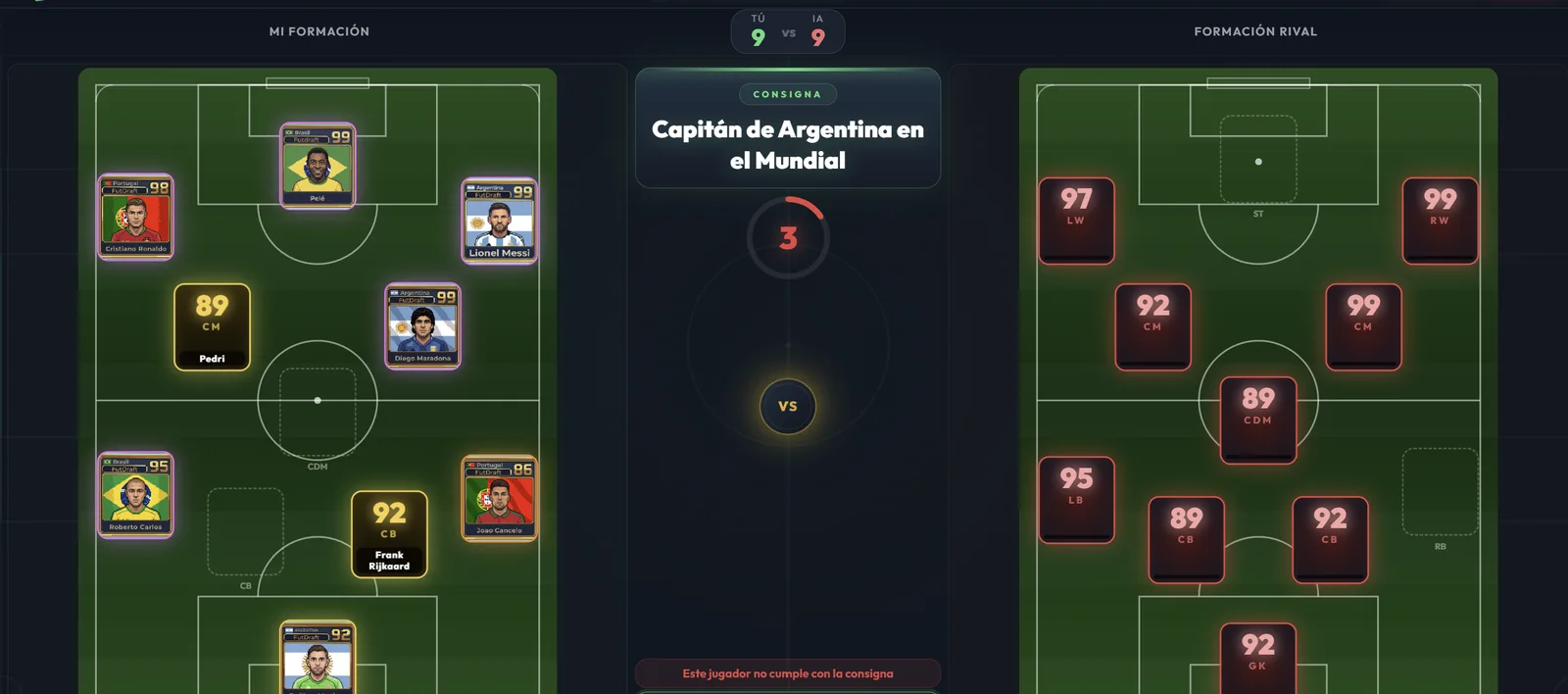
What is FutDraft?
FutDraft is a competitive football game where you build a team by picking real players who fit football clues. Every match poses eleven clues — one for each position on the pitch — and your job is to find, for each one, the player who fits best. It's not about managing a budget or memorizing exact stats: it's about knowing football.
Tap any block to expand the full explanation.
The concept: a draft won on judgment, not budget
The word "draft" is usually associated with splitting players between teams or spending an imaginary budget. In FutDraft the mechanic is different. You don't buy players or compete over transfers: you're given a specific football condition — for example "Won the Ballon d'Or," "Played for Barcelona," or "World Champion" — and you have to name a real player who fits it, for a specific position in the formation.
That difference completely changes the nature of the game. In a card-collecting or budget mode, whoever has the best squad wins almost every time, and building that squad depends on time played or money spent. Here everyone starts each match exactly the same way: an empty pitch, eleven clues ahead of you, and the same pool of players available. The only thing that builds up from match to match is your own knowledge.
The upshot is that your competitive edge can't be transferred. You can't buy it, you can't inherit it from an old account, and it doesn't fade if you stop playing for a month. Someone who recognizes that a World Cup-winning left-back could be Marcelo, but also Roberto Carlos or Lahm — and knows which of the three is the strongest fit for that spot — is going to win more duels than someone who only remembers the famous strikers.
Why the position matters as much as the clue
Each round doesn't just ask for "a player who fits X": it asks for a player who fits X and plays the position assigned that round. It's a double constraint, and it's where most matches get decided. Coming up with a name that fits the clue is usually easy; coming up with the strongest name who's also a goalkeeper, or a right-back, or a defensive midfielder, is a lot harder. The less glamorous positions are exactly the ones that decide the most matches, because they're the ones fewest people have practiced.
Football knowledge vs. memorizing stats
A fair question when you hear there are ratings involved is whether the game ends up rewarding whoever memorized tables of numbers. That's not the case, and it's worth explaining why.
Every player's rating exists, and it's what settles the duel for each position at the end of the match, but you never have to type it, guess it, or recall it precisely. All you need is a comparative sense: knowing that, between two players who fit the same clue, one is clearly a step above the other. You don't study that — you get it from watching football.
In practice, matches are won on three skills, and none of them is memorizing numbers. The first is range: how many different players come to mind who fit a given condition. The second is coverage by position: whether your repertoire includes defenders and goalkeepers, or is limited to the usual attackers. The third is speed: every round has a clock, so recognizing fast beats reasoning slowly.
That's why someone who's followed football for years and has never seen a ratings table tends to perform well from their very first match, while someone who memorized a hundred numbers but doesn't know who played where gets stuck the moment a clue moves past the most obvious names.
How it's different from a fantasy game, a manager, or a card mode
FutDraft shares raw materials with other football games — real players and ratings — but the game loop is different in almost every other way. Side by side:
- Versus a league fantasy game: a fantasy game depends on real-world matchday performance; you play and then wait days to find out how you did. A FutDraft match is settled entirely within a few minutes, and the result depends only on your decisions — not on whether a striker had a goal disallowed on Sunday.
- Versus a manager game: a manager game is long-term management — contracts, tactics, seasons. Here there's no economy or squad to manage: every match stands on its own and starts from zero.
- Versus a pack-and-card mode: there, progress means getting better players, and whoever's accumulated more has a real competitive edge. In FutDraft cards exist, but they're purely cosmetic: they change how your player looks on the pitch and nothing else. Two people with opposite collections compete on completely equal footing.
- Versus football trivia: trivia has a single correct answer. Here there are almost always dozens of valid answers, and the real question is which one is the strongest fit for that position. It feels more like a decision than a test.
Put together, that makes a game you can learn in one match, play in a few minutes, and still has a high skill ceiling: there was always a better pick than the one you made, and figuring out which one is half the fun.
The database: 3,300+ real players
Behind the game there's a database of more than 3,300 real players, each with their position or positions, nationality, clubs, and rating. That's what makes it possible for an open clue like "played for Real Madrid" to return a wide range of valid answers instead of three predictable names.
That same database is also what validates your picks and settles the duels at the end of the match, so it's identical for everyone: there are no exclusive players, nothing to unlock, and no upgraded versions of the same player reserved for certain accounts.
A technical detail with a direct effect on how the game feels: the first time you log in, that database downloads and gets stored right in your browser. From then on, when you type a name during a round, the search happens locally, with no round trip to the server. That's why results appear as you type, with no noticeable lag — which matters quite a bit when you've got a twenty-second clock.
What you need to get started: almost nothing
FutDraft runs in the browser. There's nothing to install, no client to download, and you don't need a powerful computer: if you can read this page, you can play.
You don't need an account to look around, either. Guest mode lets you browse the game modes, the global ranking, the weekly leagues, and the shop without registering, so you can see what it's about before deciding anything. The free account only becomes necessary once you want to play real matches, because that's what lets you save your progress, your level, your trophies, and your league position.
And if you'd rather play from your phone, there's an app for Android and iOS, sharing the same account and the same synced progress.
How do you play?
A match is eleven rounds, one for each position in the formation, with twenty seconds to solve each one. At the end, your team is compared against your opponent's position by position, and whoever wins more head-to-head duels wins. That's the whole rulebook — what follows is the detail behind each piece.
The formation: eleven spots, a 4-1-2-3
Every match is played with the same formation, a 4-1-2-3, and that shape is identical for you and your opponent. That's deliberate: since it's the same for both sides, no win can be explained by having a more convenient tactical setup. The eleven spots you'll fill are:
- Goalkeeper (GK): one.
- Back four: left-back (LB), two center-backs (CB), and right-back (RB).
- Midfield: a defensive midfielder (CDM) and two central midfielders (CM).
- Attack: left winger (LW), center-forward (ST), and right winger (RW).
The order the positions come up in varies between matches, so you can't prepare a fixed sequence of names ahead of time. And since each position is filled only once, you can't repeat a player within the same match: if you used your best center-back in the first defensive round, you'll need to find another one for the second.
That's where one of the game's more interesting decisions comes in. When you get a position where you have two strong names, spending the better one right away feels comfortable, but it can leave you short when that part of the pitch comes up again. Managing your repertoire is part of playing well.
The round: twenty seconds, one clue, one position
Each of the eleven rounds shows you two things: the clue you need to fit and the position you need to fill. From there, a twenty-second clock starts running.
Twenty seconds is enough to think of a name and type it, but not enough to second-guess yourself much. That's by design: the game rewards immediate recognition over exhaustive mental review. When the clock hits zero without a confirmed pick, that position stays empty and automatically loses its duel when the teams are compared.
An empty position is always worse than a poorly filled one. If you've got three seconds left and haven't found the ideal player, putting in any valid player for that spot at least leaves you a chance your opponent did something worse. Giving up on the round leaves you none.
The order matters less than it seems
Since every round is settled against the same position on your opponent's team, there's no strategic advantage in "saving" rounds — you don't choose what order to face the positions in. The only thing you're managing is your own repertoire of names.
Search and pick: how you fill a position
To fill a position, you type the player's name into the search box and pick them from the results. The search works with partial matches, so you don't need to type the full name or get an accent mark right — the first few letters are enough for them to show up.
Since the player database is already stored in your browser, results update as you type, with no delay. It's a small detail that makes a big difference with a twenty-second clock: you can type three letters, see what comes up, and change course if the name you had in mind isn't there.
A practical tip for your first matches: type last names, not full names. It's faster, and it avoids the issue of players known by a nickname or a name different from the one on their passport.
Green or red: validation is instant
As soon as you confirm a pick, the server checks whether that player actually fits the round's clue and hands back the verdict instantly. If they fit, the position turns green and the player takes their spot on the pitch. If they don't, it turns red.
Getting an instant verdict has an important consequence: you never finish the match blind. You know at all times how many positions went your way, so by the time you reach the last round you already have a pretty clear idea of where you stand.
Validation always happens on the server, never in your browser. That's what guarantees the standard is identical for everyone, and that a match's result never depends on the device you played from.
The final tally: eleven duels, not an average
Once the eleven rounds are done, the two teams get compared, and here's the rule that shapes how you should play more than any other: the comparison is position by position. Your goalkeeper goes up against your opponent's goalkeeper, your left-back against theirs, and so on for all eleven spots. Each duel is won by the player with the higher rating, and the match is won by whoever takes more duels.
Nothing gets averaged. This isn't a minor detail — it means a team with a better average can absolutely still lose the match. If you have three absolute stars and eight weak spots, you win three duels by a landslide and lose the other eight — and the huge margin on those three doesn't count for anything, because every duel is worth exactly one.
That's where the game's most useful strategic advice comes from: consistency pays off more than peaks. Covering all eleven positions with solid players wins more matches than building a dream attack and neglecting the back line. The defensive positions and the goal — the ones fewest people practice — are usually where the scoreline gets decided.
An empty or red position automatically loses its duel, no matter what your opponent put there. If both sides win the same number of duels, the match ends in a draw.
Hint: spending FutCoins to get unstuck
When a clue leaves your mind blank, there's the Hint. It costs 25 FutCoins and reveals up to three players who do fit that round's clue.
That said, the Hint shows the name and the position, never the rating. That limit is deliberate, and it's what stops the mechanic from solving the match for you: it unblocks you when nothing comes to mind, but you still have to decide which of the candidates is the strongest fit for that spot. The decision — the part of the game that actually matters — stays yours.
There are three rules for using it, worth keeping in mind before you count on it:
- Maximum three uses per match, so it's not enough to cover all eleven rounds.
- Can't be requested with less than eight seconds on the clock, because the answer needs a moment to arrive, and there'd be no point spending it if you couldn't use it in time.
- Paid for with FutCoins, the currency you earn by playing, so its real cost is whatever else you could have bought with those coins.
It's available in both Daily Challenges and Head to Head, and the three-use limit is counted per match, not per day.
Experience, levels, and progress
Every match grants experience (XP), whether you win or lose, and that XP feeds a single account level shared across every mode. What you earn in Daily Challenges, Head to Head, and World Cup Mode all goes to the same place.
Having a single, shared level reflects a concrete idea: someone who prefers playing only against the AI shouldn't be shut out of progress, and neither should someone who only plays 1v1. You can progress through whichever mode you like best, without feeling like you're wasting time by skipping the others.
Level is a measure of how much ground you've covered, not of skill — it reflects how much you've played, not how well. The competitive measure is something else — it's the trophies in the ranking and your tier in the weekly leagues, which do rise and fall based on results.
Game modes
Every mode shares the eleven-round, clue-based mechanic, but the opponent, the pace, and what's on the line all change. You can switch between them freely — nothing needs to be unlocked, and you don't have to finish one to access the next.
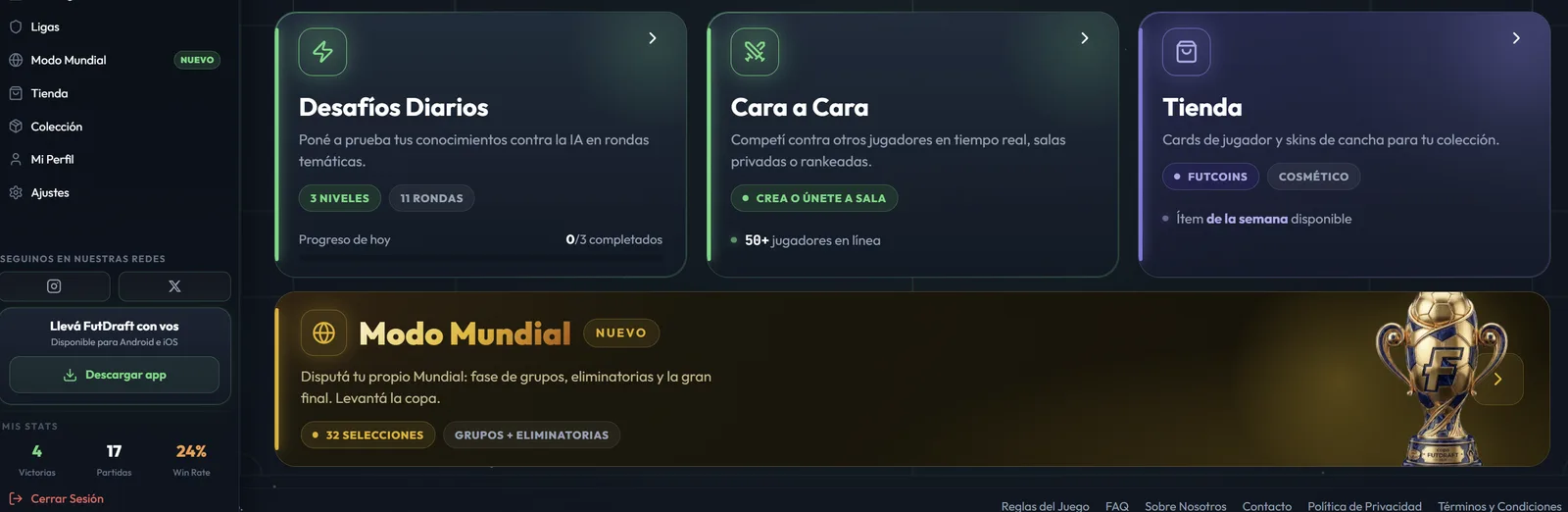
Daily Challenges — against the AI, three levels a day
This is the mode for playing solo, with no waiting on an opponent. Three challenges refresh every day, one per difficulty level, and each one can be played for a reward once a day.
What changes between levels isn't just the theme of the clues, but how strong a team the AI builds against you. That's the number worth checking before you pick:
| Level | AI level | Reward |
|---|---|---|
| Easy | 75–80 | +120 XP and up to 5 FutCoins |
| Medium | 81–86 | +260 XP and up to 10 FutCoins |
| Hard | 87–91 | +450 XP and up to 20 FutCoins |
Easy works with popular, widely known players — it's the one to figure out the mechanic without getting frustrated. Medium already calls for specific knowledge of squads and competitions. Hard goes after fine-grained detail from the top leagues, and it's where the mode gets genuinely demanding.
One quirk: the AI "thinks" before revealing each pick, and that wait gets shorter the harder the level. It's purely for show — its picks are already decided ahead of time — but it gives the challenge a pace similar to facing a real person.
Since each day's progress is tracked, the home screen keeps count of how many of the three challenges you've completed today. It's the most predictable way to build up FutCoins, because it doesn't depend on finding an opponent or on winning.
Head to Head — real-time 1v1 against another person
This is the game's competitive mode. Two real people play the same eleven clues at the same time, each on their own screen, with the same clock running for both. As you play you can see which positions your opponent has already filled, though not which player they put there: you know their pace, not their picks.
Two ways into a match
- Matchmaking: the system automatically pairs you with another person also looking for a match at that moment. It's the direct route if you want to play right now and don't care who against.
- Private room: you create a room, get a code, and pass it along to whoever you want. That person enters it and you both join the same match. It's the route for playing against someone you know instead of a stranger.
What's on the line
Every match hands out two different things, and it's worth not mixing them up, because they behave in opposite ways:
- Experience: 80 XP, and you collect it always — whether you win, lose, or draw. XP never goes down.
- Trophies: +25 if you win, 0 if you draw, and −20 if you lose. Trophies can go down, and they're what determines your spot in the ranking and your fate in the weekly league.
That asymmetry is what makes the mode feel genuinely competitive: playing always leaves you with something, but losing carries a real cost to your standing.
There's also a daily cap on matches that grant rewards, and the mode's screen shows you how many you have left. Past that cap you can keep playing as much as you want — those matches just stop adding up.
If your opponent quits mid-match, the win goes to you along with its rewards. And if their connection drops, the game waits a moment for them to come back before calling the match over — a brief internet hiccup doesn't cost you an automatic loss.
World Cup Mode — your own tournament, decided on penalties
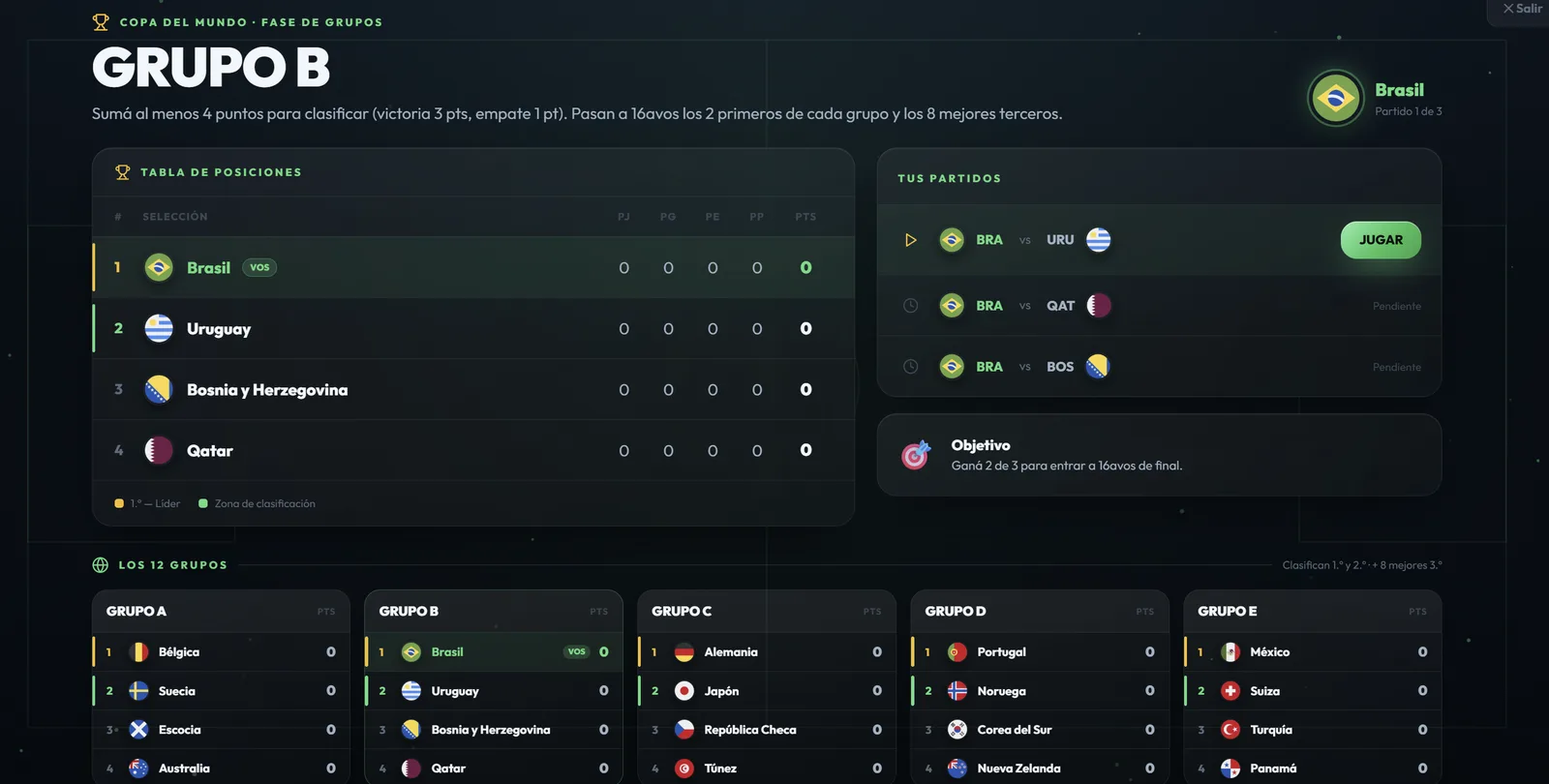
World Cup Mode is the longest and most different of the three. You pick a national team from 48 available and play a full tournament: a draw, group stage, and knockout rounds all the way to the final. Instead of being settled by clues, every match is decided on penalties.
The draw and the group stage
The 48 national teams are split across four pots, and the tournament kicks off with a draw that builds twelve groups respecting that split, just like a real World Cup. You watch the draw play out and find out right then who you're up against. After that, you play your group while the rest of the groups get resolved in parallel.
32 teams advance to the next stage: the twelve group winners, the twelve runners-up, and the eight best third-place teams. So finishing third doesn't eliminate you automatically, but it leaves you depending on what happened in the other groups.
How each match is played
Every penalty has two parts, and this is the mode's twist. First you get a football trivia question: answer it correctly and you earn the right to shoot; get it wrong or run out of time and you lose your turn outright. Only then do you choose which side to shoot for, against a goalkeeper who's also picking a side.
Then the roles flip and it's your turn to save: you pick which way to dive, and the outcome plays out from the goalkeeper's point of view. The shootout runs five penalties per side, and if it's tied at the end it goes to sudden death, with harder questions.
Mixing trivia with penalties is what keeps the mode from coming down to pure luck: getting the questions right guarantees you more shots than your opponent, and over time that difference matters more than the coin-flip of a single side.
The Life: a second chance in the knockout rounds
If you get eliminated in the knockout rounds — not the group stage — you can pay FutCoins to revive your tournament and replay that same round against the same opponent, with new questions and penalties. It can only be used once per tournament, and the lost attempt still gets recorded in your history. It's the difference between losing a tight quarterfinal and having to start an entire World Cup over.
Ranking and Leagues — the weekly competition
The trophies you win and lose in Head to Head feed two different standings, and understanding the difference between them clears up a lot of confusion.
The global ranking is cumulative: it's your total trophy count and your standing among every player. It never resets.
The leagues, on the other hand, are weekly. There are six tiers, and every week starts from zero:
- Sandlot — where everyone starts.
- Youth League
- Reserve
- First Division
- Star
- Legend — the highest tier.
Here's something that surprises a lot of people: within a league, standings aren't ordered by total trophies, but by the trophies you earned that week. Your history gives you no head start. Someone who's been playing for months and someone who just signed up compete, within the same league, purely on what they do during the current week.
At the end of the week, promotions and relegations kick in, and the proportions change by tier — moving up is easy at the bottom and hard at the top:
| League | Promoted | Relegated |
|---|---|---|
| Sandlot | 50% | — |
| Youth League | 40% | 10% |
| Reserve | 30% | 20% |
| First Division | 25% | 25% |
| Star | 20% | 30% |
| Legend | — | limited spots |
Nobody gets relegated from Sandlot, so there's no risk in starting out. Legend has no promotion above it — it's the ceiling — and it holds a limited number of spots, so staying there means competing every single week. Your league's table always shows you which zone you're in and how much time is left before the week closes.
Shop and Collection — cosmetic, no competitive edge
The FutCoins you earn by playing get spent in the shop, and everything in it is purely cosmetic. Nothing you buy improves your performance, gives you better players, more time per round, or any other edge over your opponent.
The main catalog is player cards: more than 130 designs that replace a player's default plaque when you put them on the pitch. It's a visual change, and it only shows up if that player is actually the one you picked in that match. Cards don't need equipping — owning them is enough.
Pitch skins are announced and visible in the shop, but can't be purchased yet — it's a section still being built, not an item hidden behind a paywall.
There's a weekly rotation that features one item and switches on its own when the countdown runs out, the same for every player. The Collection is where you see what you already own.
The reason all of this is cosmetic is the same idea that runs through the rest of the game: if the shop could improve your team, matches would stop measuring football knowledge and start measuring how much you spent. That's exactly the outcome the design is built to avoid.
Frequently asked questions
The questions that come up most, with the full answer. If yours isn't here, write to us from Contact.
Is it free? Is there anything you pay for?
Playing is completely free. There's no subscription, no premium tier, and no match limit behind a paywall: every mode — Daily Challenges, Head to Head, and World Cup — is fully available from day one, at no cost.
The only things you can buy are cosmetic items: player cards and, down the line, pitch skins. They change how your team looks and nothing else. They don't improve your players, don't give you more time per round, don't boost your rewards, and don't affect the outcome of any match.
On top of that, those items are bought with FutCoins, the currency you earn by playing. So you can build your whole collection just by playing, without spending real money.
Do I need to create an account?
Not to browse. Guest mode lets you explore the game modes, the ranking, the leagues, and the shop without registering, so you can see exactly what it's about before deciding anything.
To play matches, yes, you need an account, and it's free. The reason is practical: without an account there's nowhere to save your level, your FutCoins, your trophies, or your league tier, and the 1v1 mode needs to identify both participants to assign a result.
Signing up takes less than a minute. You can do it with an email and password, or sign in directly with your Google account.
Is there a mobile app? Is progress shared?
Yes, FutDraft has an app for Android and iOS in addition to the web version. It's the same account: if you sign in with your details on your phone, you'll find your level, your FutCoins, your trophies, and your collection exactly as you left them on the computer, and vice versa.
The app is the recommended way to play from your phone. This web version is built for larger screens — the pitch, the search box, and the scoreboard all need room to work well — so if you visit from a phone, we'll point you to the app instead of showing you an awkward layout.
How do I get FutCoins?
By playing. All three modes hand out FutCoins when you finish a match, in different amounts.
The most predictable route is Daily Challenges, since it doesn't depend on finding an opponent or winning: up to 5 coins on Easy, up to 10 on Medium, and up to 20 on Hard, once a day each. Head to Head pays out too, with a daily cap on rewarded matches, and World Cup Mode pays based on how far you get in the tournament.
There are also promo codes you can redeem in the shop, which we announce on our social media.
Keep in mind FutCoins get spent on two different things: the cosmetic collection and the in-match Hint, which costs 25 per use. If you're saving up for a card, every Hint pushes that a little further away.
How do I move up a league tier?
By winning Head to Head matches during the current week. Within your league, the table is ordered by the trophies you earned that week, not by your all-time total, and at the end of the week a percentage of the top spots gets promoted.
That percentage depends on the tier: in Sandlot half the table gets promoted and nobody gets relegated, while in the higher tiers fewer get promoted and more get relegated. In Legend there's no promotion possible since it's the ceiling, and the spots are limited.
The practical takeaway: if you want to move up, what matters is concentrating your matches within the same week. Ten wins spread across a month count for a lot less than ten wins in one week, because the count resets to zero every week.
I lost even though my team had a better average — why?
Because it's not the teams' averages that get compared, it's each position on its own. Your goalkeeper against theirs, your full-back against theirs, and so on for all eleven spots. Whoever takes more of those eleven duels wins the match.
So yes, it's perfectly possible to have a team with a better average and still lose. If you win four duels by huge margins and lose seven by tiny ones, your average is higher and the result is still 7–4 against you. Every duel is worth one, no matter by how much you won it.
It's the single most important rule for playing well, and it leads to one clear conclusion: being consistent beats being spectacular. Covering the goal and the defense well wins more matches than reinforcing an attack that was already solid.
What happens if my internet drops or I close the tab by accident?
In Head to Head, if your connection drops, the game tells your opponent you're reconnecting and waits a moment before calling the match over. A brief hiccup doesn't cost you an automatic loss.
If the disconnection drags on, or you quit the match, it counts as a win for your opponent, with the rewards that come with it. That has to be the rule: if quitting had no cost, anyone who saw a loss coming would just close the tab.
That's why, while a match is in progress, the game asks you to confirm before letting you leave with the browser's back button or by closing the tab. It's not a bug — it's there so you don't lose a match to an accidental click.
What happens if I don't pick in time?
That position stays empty and automatically loses its duel when the teams are compared, no matter what your opponent put there.
That leads to a practical rule worth picking up early: if you're down to a few seconds and haven't found the ideal player, put in any valid player for that spot anyway. A weak pick can still beat an even weaker one from your opponent, or the gap they left behind. An empty slot beats nothing.
Can I use the same player twice in one match?
No. Each player can be used only once per match, so once you've placed them in a position, they're no longer available for the following rounds.
This adds a layer of decision-making that mostly shows up in the duplicated positions — the two center-backs and the two central midfielders. When the first of those spots comes up, spending your best name locks in that duel but leaves you with less to work with if that zone comes up again. There's no universally correct answer — it depends on how deep your repertoire is at that position.
Does the Hint tell me who the best player is?
No, and that's on purpose. The Hint shows you up to three players who fit the clue, with their name and position, but never their rating. Which of the three is the strongest is a call you have to make yourself.
The idea is for it to unblock you when literally nobody comes to mind, without solving the part of the game that actually matters. If it also showed ratings, buying a Hint would always be the optimal move, and the game would stop measuring knowledge.
It costs 25 FutCoins, can be used up to three times per match, and isn't available with less than eight seconds left on the clock.
I found a bug or want to suggest something — where do I say it?
Inside the game there's a Suggestions and Reports button, available after finishing a match and in the Settings section. When you submit one, you get a ticket number — worth saving if you want to follow up later.
That channel is the most useful for us, because the report arrives with the context of what you were doing — the mode, the difficulty, the tournament stage — and that's often the difference between being able to reproduce an issue and not.
If you'd rather write to us outside the game, you'll find the details in Contact. We read everything, even if we can't always reply to every message individually.
I forgot my password
On the login screen, the "Forgot your password?" option sends a verification code to the email you registered with. With that code you can set a new password, and you'll be signed in right away.
If it doesn't arrive, check your spam folder before requesting another one. And if you originally signed in with Google, there's no password to recover — just keep signing in with the Google button.
Want the rulebook summed up on a single page? It's in Game Rules. More questions, in the FAQ. If you came looking for free online football games, some football trivia, or how to play with friends, each topic has its own page.